On this page
- Why Sizing Matters More Than You Think
- What You Need Before You Start
- The Three Measurements That Actually Matter
- When to Measure: Time of Day Actually Matters
- The Beginner Mistakes I Made (So You Don’t Have To)
- When to Buy a Modular Kit (and Which Ones Are Worth It)
- What Mistress Wants You to Hear About Safety
- Frequently Asked Questions
You have the tab open right now, don’t you. A cage in a basket you haven’t dared to confirm, a browser window you close when anyone walks past. I know that window, sissy. Five years ago it was mine.
So let me tell you something embarrassing, darlings.
The very first chastity cage I ever ordered was the wrong size in every single dimension. The ring was too small, the cage was too long, the gap was non-existent. I had spent two weeks waiting for it to arrive, hands shaking, fantasising about who I was about to become once Mistress turned the key in me for the first time. Within forty minutes of putting it on I was in tears, and not the good kind. I had to text Mistress in a panic, the woman I had been begging to lock me away, and beg her instead to help me get out.
Five years later, I have learned a lot about how to measure properly. I want to give you all of it here, so you can skip the panic and go straight to the good part.
This is a guide written for sissies, by a sissy. I’ll tell you what worked, what didn’t, and what Mistress finally taught me when I was ready to listen.
Why Sizing Matters More Than You Think
I want to be very honest with you before we begin, sissy.
A wrongly-sized chastity cage is not just uncomfortable. It can cause real harm, chafing, swelling, restricted blood flow, and in extreme cases, lasting damage. I am not telling you this to frighten you. I am telling you so that you take this part seriously, even if you are impatient (I was), and even if you’ve already added a cage to your basket online (I had).
The good news is: measuring properly takes about ten minutes, and once you know your numbers, you know them. Most sissies use the same measurements for years. The better the fit, my darling, the more the cage fades into the background of your day, until you stop noticing it and start noticing the warm constant ache underneath, which is, sissy, the whole point of the practice.
So put the basket aside for one evening. Sit with me. Let me walk you through this.
What You Need Before You Start
Gather these things in advance:
A few brands sell dedicated sizing kits with plastic ring samples and a measuring band, Holy Trainer, CB-X, and a few others. If you have the budget for one (around $25-40), I genuinely recommend it. Mistress made me buy one after my third sizing mistake, and it was the moment my chastity practice actually became safe.
The Three Measurements That Actually Matter
There are only three numbers you need. Don’t let any guide tell you otherwise. Ring size, cage length, gap. That’s it. All three are cage numbers, sissy, so if you have not actually decided on a cage yet, a belt is measured at the waist and asks a completely different question, and it is worth settling that before you measure anything.
Ring Size: The Most Important One
The ring is the part of the cage that sits at the base, behind everything. It is what holds the device on. If the ring is wrong, nothing else matters.
To measure:
- Make sure you are at room temperature, not aroused, and ideally not first thing in the morning. (More on that in a moment.)
- Take your soft tape and measure the circumference of the area where the ring will sit, the soft, sensitive area just behind your testicles, the part of you about to be quietly taken offline by someone else’s decision.
- Wrap the tape gently. Don’t pull tight. You should be able to slip a fingertip under it comfortably. Tight enough to stay put, loose enough to never pinch.
- Note the measurement in millimetres. This is your circumference.
- To get your ring diameter (which is what most brands sell by), divide your circumference by π (3.14). So a 145mm circumference is roughly a 46mm ring diameter.
Most beginners fall somewhere between 45mm and 50mm ring diameter. If your circumference is between two sizes, always go up to the larger ring. A slightly loose ring is uncomfortable; a slightly tight ring is dangerous.
Cage Length
The cage is the part that contains your flaccid length. If it’s too long, the cage will pull forward and the ring will slip; if it’s too short, you’ll be uncomfortable and won’t fit cleanly inside.
To measure:
- Same conditions as before, room temperature, not aroused.
- Take your soft tape and measure your flaccid length along the top, from the base to the tip. (The only state your Mistress wants the device to know, by the way. The other state belongs to her now, on her timeline, not yours.)
- Note that measurement in millimetres.
- Subtract about 5-10mm. The cage is meant to fit your flaccid self snugly, not loosely. A slightly shorter cage gives a more secure fit and is more comfortable than a too-long one.
Most beginner cages run between 55mm and 80mm in length. Don’t be precious about which “size” you are. Pick the cage that matches your number, that’s all.
The Gap
The gap is the small space between the back of the cage and the front of the ring. It’s the most-forgotten measurement, and the one that causes most of the daily comfort issues you’ll read about online.
The gap exists for two reasons: it accommodates the soft tissue at the base, and it allows for the small natural movement of the body during the day.
For most beginners, a gap of 5 to 10 mm is ideal. Less than 5mm and the cage will pinch every time you sit down. More than 15mm and the cage will pull forward, the ring will rotate, and the whole device will feel insecure, and a device that feels insecure makes it very hard to fall into the sweet helpless quiet the practice can give you.
Almost all beginner-friendly cages, Holy Trainer V4, CB-6000, Cobra, and most modern silicone or resin models, come with multiple gap spacers of different sizes (usually 5mm, 10mm, 15mm, sometimes more). This is part of why I ended up recommending modular kits.
When to Measure: Time of Day Actually Matters
This is the mistake I made on my first attempt, darlings, and I wish I had known.
Do not measure first thing in the morning. Do not measure right after a hot shower, right after exercise, or in a cold room. Each of these will give you a measurement that is either too small or too large compared to what you’ll experience most of the day.
The best window I’ve found, after years of doing this:
The body changes throughout the day. The cage you’ll wear for hours at a time needs to fit the average you, not the smallest possible you.
Bee’s rule, from the evening she finally sized me herself, handed to you the way she handed it to me: measure tonight, three times over ten minutes, write down the average, and then do not order anything for twenty-four hours. The pause is part of the practice. If the wanting survives a full day of knowing your numbers, it was never impatience, sissy. It was you. And if you are measuring in late September with an October in the cage in mind, the twenty-four hours still stand : a cage that arrives on the fourth is better than a ring that was guessed on the first.
The Beginner Mistakes I Made (So You Don’t Have To)
A short, painful list, in honour of my first six months:
If you only take one of these to heart, my fellow sissy, take the last one. Always have a backup key.
When to Buy a Modular Kit (and Which Ones Are Worth It)
After three failed cages and one very uncomfortable evening that gave us both a real fright, Mistress told me to stop guessing and invest in a proper sizing kit.
Two beginner-friendly options I would recommend:
- Holy Trainer V4 Sizing Kit, comes with multiple ring sizes, multiple cage lengths, and several gap spacers in lightweight resin. Around $30. This is the kit Mistress eventually had me buy, and I have used it as my reference for every cage I’ve owned since.
- CB-X Sizing Kit, slightly more expensive (around $40) but covers a wider size range and includes a basic introductory cage you can actually wear short-term.
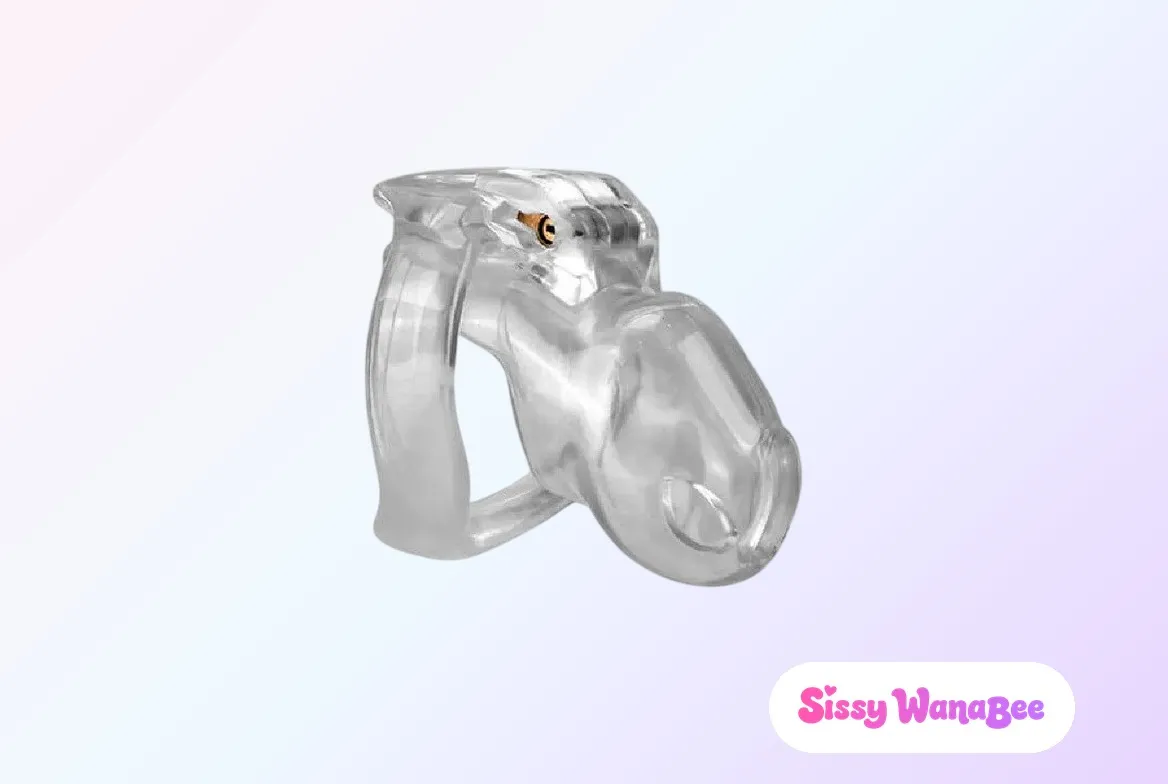
If you’d rather not buy a separate sizing kit, the Holy Trainer V4 cage itself ships with multiple rings and spacers in the box, so even if your measurements turn out to be slightly off, you can fine-tune the fit without ordering anything else. That’s why so many beginners (myself eventually included) start there.
What I would not recommend for a first cage:
What Mistress Wants You to Hear About Safety
Frequently Asked Questions
What if I'm between two ring sizes?
Always go up. A slightly loose ring is mildly annoying ; a slightly tight ring can cause real harm over hours of wear. You can always order a smaller ring later if the larger one truly slips. You cannot un-injure tissue that has been pinched for a full day.
Should I measure when I'm aroused or flaccid?
Always flaccid, calm, room temperature. A chastity cage is designed to fit your everyday self, not your most aroused self, and not your coldest self. Your flaccid length and ring circumference are what the device needs to accommodate.
How do I know if my cage is the wrong size after I start wearing it?
Watch for persistent pinching, rotation of the cage when you walk, the ring sliding or falling off, redness that doesn't fade after removal, numbness, sharp pain, or any change in skin colour. Mild discomfort in the first hour is normal as you adjust. Anything that gets worse over time means the size is wrong, take it off and reassess.
Can my measurements change over time?
Yes, slowly. Weight changes, hormonal shifts, and even seasonal changes can affect ring size by a few millimetres. Most sissies re-measure once a year or whenever they feel the cage starting to fit differently. Modular kits make this much easier to track.
Do I really need a backup key?
Yes, my darling. Yes, yes, yes. Sealed envelope, known location, accessible in any emergency, even one you can't predict. The fantasy of "no escape" can survive a safety net. Your body cannot survive a missed emergency.
P.S. The first time I ever wore a properly-sized cage, after months of fumbling, Mistress locked me herself and kissed the top of my head. I sat on the bed and just laughed, and then I cried a little, and then I felt the most extraordinary warm calm settle through my whole body, the kind that says you finally belong to someone who knows what to do with you. It felt that different. Worth every minute of measuring, darlings. Truly.